

From CPQ to Revenue Cloud: Why Banking, Financial Services, and Insurance Leaders Must Rethink Revenue Operations

Introduction
For decades, financial institutions relied on manual, paper-heavy processes to move from quote to approval. Even as Salesforce CPQ (Configure, Price, Quote) brought automation to sales and policy quoting, the cycle still ended prematurely. Billing, renewals, compliance, and revenue recognition often lived in separate systems — creating inefficiencies that drained margins.
Today, this fragmented approach is no longer sustainable. According to EY, banks and insurers lose up to 5% of potential revenue each year due to operational leakage in their quote-to-cash cycle. In an era of razor-thin margins and rising compliance pressure, CFOs and COOs cannot afford such gaps.
This is why the conversation is shifting from CPQ to Revenue Cloud, Salesforce’s unified approach that brings together quoting, billing, contracts, and revenue recognition into one lifecycle.
The Rising Cost of Outdated Revenue Models in BFSI
Financial institutions face three structural challenges that legacy revenue processes cannot address:
Complex financial products: Loans are now bundled with insurance, cards, and digital services. Policies include riders, add-ons, and tiered pricing. Legacy CPQ handles configuration, but not the billing and renewals that follow.
Regulatory demands: With IFRS 15 and ASC 606 revenue recognition standards, regulators expect precision and transparency. Siloed systems leave CFOs exposed to audit risks.
Customer impatience: A PwC survey found that 73% of banking customers expect near real-time approvals. Manual reviews or disconnected billing workflows erode trust and push clients toward fintech challengers.
The cost isn’t just in lost revenue. It’s in the erosion of customer trust — an asset banks and insurers cannot afford to lose.
From CPQ to Revenue Cloud: A Strategic Pivot for BFSI
Salesforce Revenue Cloud builds on CPQ’s strengths but extends well beyond quoting. For BFSI institutions, it means:
- End-to-end lifecycle visibility. A unified platform covering quotes, billing, contracts, renewals, and revenue recognition.
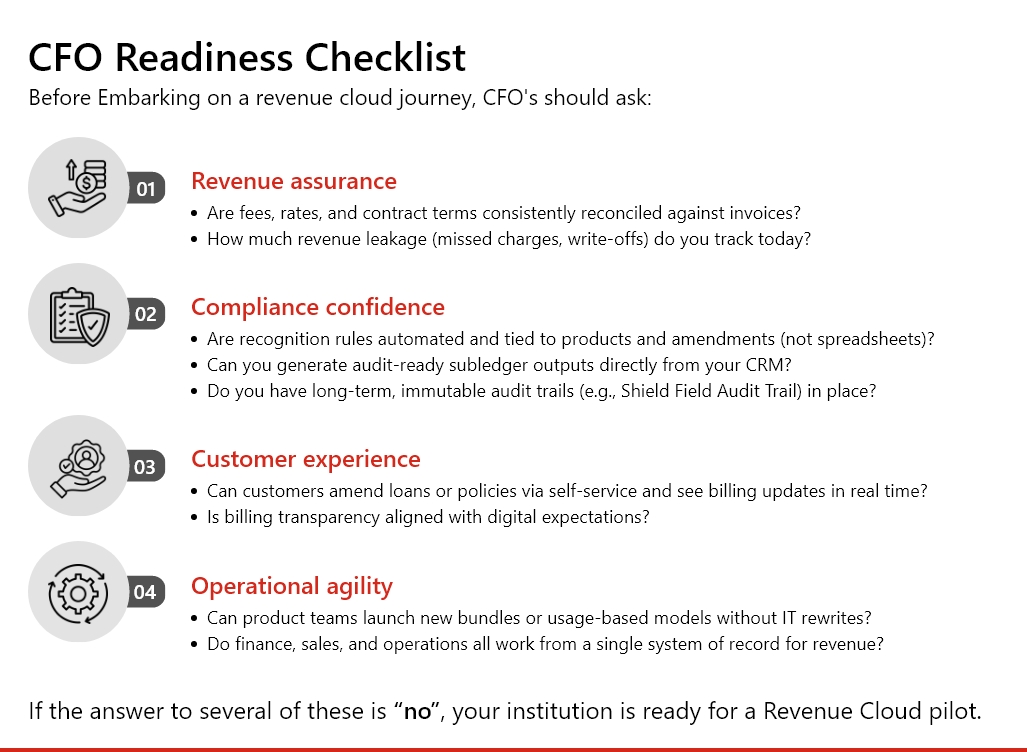
- Revenue assurance through automation. Built-in controls prevent leakage from missed fees, incorrect rates, or manual errors.
- Compliance by design. Recognition standards and accounting-ready subledger outputs reduce exceptions during regulatory reviews. For extended, immutable audit logs, Salesforce Shield provides Field Audit Trail.
- Agility for new business models. Subscription-like insurance products, bundled offerings, and recurring banking services become easier to launch and monetize.
Instead of patching together systems, Revenue Cloud acts as the connective tissue of revenue operations — aligning finance, operations, and compliance with the speed customers demand.
Why Revenue Cloud Is Outpacing CPQ in Enterprise Adoption
Salesforce CPQ has been the trusted solution for accurate quotes and faster approvals, but in recent years, many enterprises are making the pivot to Revenue Cloud. The reason is simple: business models have changed, and CPQ alone no longer covers the entire revenue journey.
- Subscription and Usage-Based Models Are Mainstream
From SaaS to telecom to insurance, recurring and consumption-based products are now the norm. Revenue Cloud was designed for these models — handling subscriptions, amendments, renewals, and usage-based billing in ways CPQ was never intended to. - CFOs Demand Compliance and Recognition Accuracy
Global standards like IFRS 15 and ASC 606 have made revenue recognition a board-level concern. CPQ ensures quotes are accurate; Revenue Cloud ensures the revenue lifecycle is compliant from contract to subledger and ERP. That’s a major reason CFOs see it as a safer long-term investment. - The Customer Journey Doesn’t Stop at the Quote
Today’s customers expect self-service amendments, real-time billing visibility, and seamless renewals. Revenue Cloud integrates with customer-facing portals and APIs, enabling organizations to extend transparency all the way through the lifecycle. - Businesses Need One System of Record for Revenue Operations
Disconnected CPQ, billing, and finance systems create leakage and disputes. Revenue Cloud offers a single revenue backbone where Finance, Sales, and Operations work from the same source of truth. The general ledger remains in the ERP, but Salesforce provides the operational system of record for revenue. - Faster Time-to-Value and Agility
Enterprises don’t just want accurate quotes — they want to launch new revenue models faster. Revenue Cloud gives product teams the flexibility to introduce bundles, discounts, or new recurring offerings without heavy IT customization.
The acceleration of Revenue Cloud adoption isn’t about replacing CPQ — it’s about extending it. Enterprises that once saw CPQ as the end of the sales cycle now realize it is only the beginning of a more critical revenue lifecycle.
“Thinking about moving from CPQ to Revenue Cloud? Speak with our Salesforce experts to evaluate readiness and next steps.”
The Measurable Impact: From Leakage to Growth
The transformation is already evident in institutions embracing Revenue Cloud:
- Faster approvals. Hero FinCorp reduced loan approvals from 2 days to 30 minutes by integrating Salesforce with underwriting and finance. Digital bank Nano processes approvals in under 10 minutes.
- Reduced leakage. Customers report reclaiming 2–5% of potential revenue by automating billing and enforcing contract terms.
- Faster closes. Revenue recognition cycles accelerate, enabling CFOs to close books sooner and with fewer audit exceptions.
- Higher customer satisfaction. Turnaround times shrink from days to hours, reinforcing loyalty.
Consider a regional bank that adopted Revenue Cloud to manage bundled products, mortgages tied to insurance and advisory services. Within the first year, approval cycles dropped by 35%, revenue leakage decreased by 8%, and compliance exceptions during audits fell by half. The result wasn’t just operational efficiency — it was restored confidence from both customers and regulators.
Recommendations for BFSI Executives Exploring Revenue Cloud
Adopting Revenue Cloud is not a “lift and shift” project. It requires a deliberate strategy to maximize impact:
- Start with high-friction products. Focus on loans or insurance lines where delays and leakage are most visible.
- Integrate core systems early. Use MuleSoft to connect Revenue Cloud with underwriting, ERP, and compliance platforms.
- Define compliance KPIs. Track revenue recognition accuracy, audit exception rates, and time-to-close metrics from day one.
- Phase the rollout. Pilot in one business line before scaling to enterprise-wide adoption.
This approach ensures not only a smoother transition but also continuous ROI delivery.

The Future of Revenue in BFSI Is Lifecycle-Driven
As margins tighten and customer expectations accelerate, BFSI institutions must rethink how revenue is managed. CPQ remains valuable, but in isolation, it stops short of addressing the lifecycle challenges that define today’s industry.
The shift to Revenue Cloud is more than a technology upgrade. It is a strategic pivot toward revenue integrity, operational agility, and regulatory confidence.
Is your bank or insurance institution ready to modernize revenue operations?
Schedule a Quote-to-Cash Assessment to explore how Salesforce Revenue Cloud can transform your revenue lifecycle.